

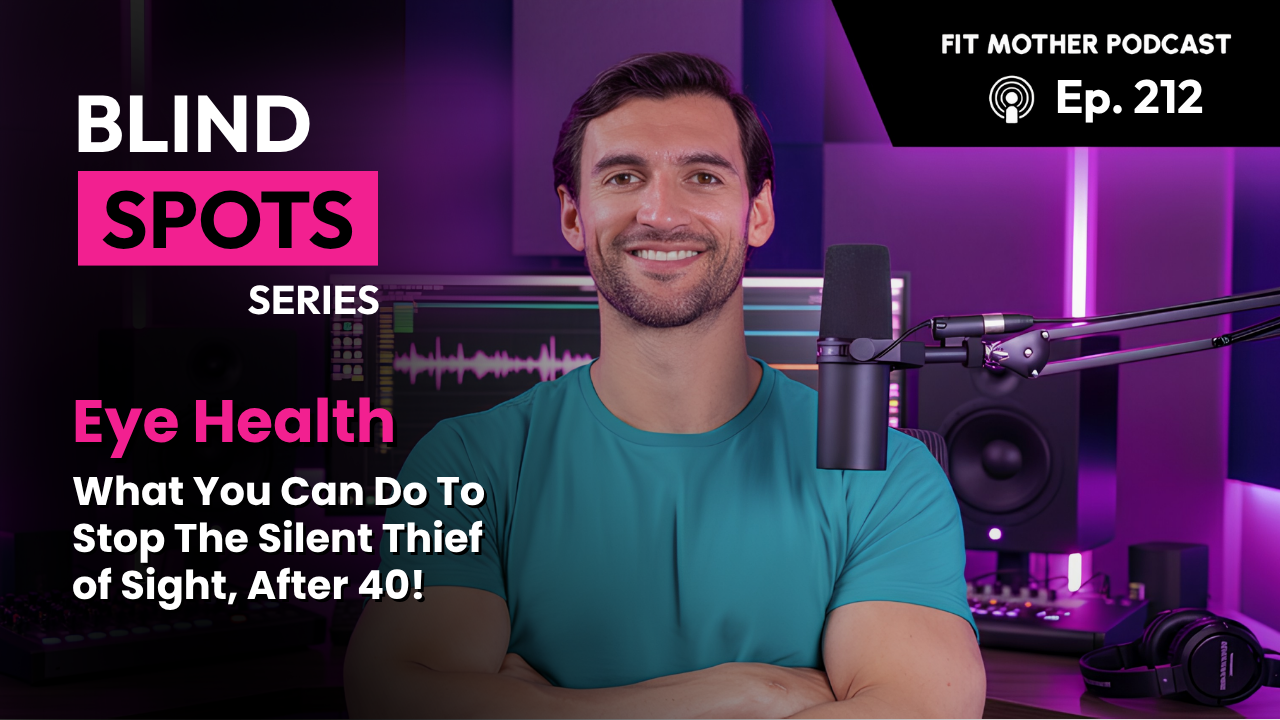
In the final episode of the Blind Spots series on the Fit Mother Project Podcast, Dr. Anthony Balduzzi covers one of the most important parts of healthy aging:
… Your eyes.
He starts with something strange. Right now, each of your eyes has a literal blind spot, where the optic nerve exits and there are no photoreceptors at all.
You’ve never noticed it because your brain quietly fills in the gap.
That same “fill in the blanks” ability is why glaucoma is so dangerous.
It takes your peripheral vision so slowly and painlessly that your brain covers up the damage.
You can lose a large amount of vision before you notice anything is wrong. Once it’s gone, it doesn’t come back.
Dr. A walks you through the six parts of the eye you should know by name.
He explains why your retina isn’t just like brain tissue — it IS brain tissue. He also covers how special light receptors in your eyes run your body clock, your mood and your sleep.
Then he gets practical.
He shares the research-backed 20-20-20 habit for screen strain, the eye drops to avoid, the foods that feed your eyes, and the exam schedule that catches the silent problems early.
If your eyes feel tired by the end of the day, or you’ve started holding the menu farther away, this episode is for you.
Rate & Review – If this episode taught you something new about your body, please take a moment to rate and review the Fit Mother Project Podcast.
Your review helps more women over 40 find practical, science-backed health information that can genuinely change their lives.
Join the Fit Mother Community – If you want support putting these habits into action, come join Fit Mother For Life.
You’ll find structured programs, real coaching and a Sisterhood of women building strong, healthy lives together.
Fit Mother Project Key Takeaways:
- Glaucoma is the “silent thief of sight.” About 4.2 million American adults have it, and nearly half don’t know. It takes your peripheral vision first, which is the hardest kind of vision loss to notice, and the damage can’t be reversed.
- Your retina is brain tissue. It grows out of the brain during development. Caring for your eyes means caring for an exposed piece of your central nervous system, and those cells don’t regenerate once they’re gone.
- Your eyes run your body clock. Special receptors in your retina contain a pigment called melanopsin, which responds most strongly to blue daytime light. They signal your brain’s master clock to regulate serotonin, melatonin, sleep and immune function.
- Get 10–20 minutes of morning outdoor light. Even on an overcast day you get far more light outside than in a bright indoor room. It does more for your body clock than any supplement.
- Dim your home at night. Blue light after sunset suppresses melatonin, which affects your sleep and recovery. Swapping evening bulbs for warmer, more orange light is an easy upgrade.
- Use the 20-20-20 habit for screen strain. Every 20 minutes, look at something 20 feet away for 20 seconds, then blink on purpose. Screens cut your blink rate, which dries out your eyes, and after 40 a stiffer lens makes the strain worse.
- Skip the “get the red out” drops. They work by narrowing blood vessels, which causes rebound redness and less blood flow to the eye. Warm compresses, preservative-free artificial tears and antihistamine drops (if you have allergies) are better choices.
- An eye exam is also a heart and metabolic check. The back of your eye is the only place a doctor can see your blood vessels and nerves directly. Diabetic retinopathy affects about 1 in 3 people with diabetes and has no early symptoms. High blood pressure and cholesterol also leave visible signs.
- Feed your eyes lutein and zeaxanthin. These carotenoids build up in the macula and protect it. Your best sources are dark leafy greens (kale, spinach, collards, Swiss chard), egg yolks, orange and yellow peppers, broccoli, squash and pistachios. A Mediterranean-style diet has the strongest research for eye health.
- Get a comprehensive eye exam on schedule. Choose a dilated exam or retinal photography. The American Academy of Ophthalmology recommends every 2–4 years from 40–54, every 1–3 years from 55–64, and every 1–2 years from 65 on. If you have diabetes, go every year. Sudden floaters, flashes or vision loss are a medical emergency.
Eye Health After 40 – The Silent Thief of Sight (Ep. 212)
Ready to Protect Your Health for Decades? Join Fit Mother For Life
You’ve been trying. GLP-1s, fad diets, workout apps, expensive supplements… and you’re still not where you want to be.
That’s not a discipline problem. You were handed pieces of the puzzle, and a piece can’t hold your whole health together.
Everything Dr. A covered in this series — your blood sugar, blood pressure, circulation, sleep and nutrition — is already built into Fit Mother for Life. If you’ve been making the shakes from the program, you’ve been getting spinach (and the lutein and zeaxanthin that come with it) without even knowing it.
It’s all in one place: workouts, nutrition, hormone and menopause support, daily lessons, real human coaching and the Sisterhood. One membership, one app, one community.
When you join, you get:
✅ FM30X, your 30-Day QuickStart Plan. Most women with weight to lose drop 8–15 lbs in their first 30 days.
✅ A real human coach. A certified trainer, not a chatbot, who reaches out within 24 hours of joining.
✅ Joint-friendly workouts for women 40+. 20–40 minutes, 2–4 times a week, at home or at the gym.
✅ Family-friendly nutrition. Cook one dinner that everyone eats. No separate “diet meal.”
✅ 15+ complete programs for fat loss, muscle building, mobility, stress and sleep, cardio and more.
✅ The Sisterhood. 6,000+ women who cheer you on and notice when you go quiet.
✅ Weekly live coaching calls plus a monthly live Q&A with Dr. Balduzzi.
$39 for your first 30 days, then $69/month. Or join for the year at $399 and lock in that rate for life. Cancel anytime. Every membership comes with a 30-day money-back guarantee.
Your body isn’t broken or over the hill. It has changed, and you deserve a plan built for the body you have now.
→ Start your first 30 days for $39
This Episode Is Brought To You By Just Thrive
If your gut is a mess, your health is a mess. You can dial in your fasting window, your workouts and every supplement on your shelf. But if your gut lining is inflamed or your microbiome is out of balance, you’re pouring your hard work into a leaky bucket.
Most probiotics don’t survive stomach acid. That’s why Dr. A only recommends Just Thrive, a spore-based probiotic built to survive digestion and work where it counts.
→ 4 clinically studied spore strains that arrive 100% alive
→ 1,000x better survivability through stomach acid
→ One strain produces antioxidants directly in your gut
→ Supports less bloating, better nutrient absorption and a stronger immune system
→ Free from dairy, soy, gluten, sugar and artificial colors, with no refrigeration needed (gummies available too)
Dr. A’s listener offer: Start a 90-day Just Thrive Probiotic subscription and get 3 FREE bottles of Digestive Bitters, an $89.97 value, added to your first shipment.
Bitters help your body make the stomach acid, bile and enzymes it needs to break down food, so it doesn’t sit and ferment. They also support your body’s natural GLP-1 production.
Prefer a one-time purchase? You can get 20% off anything in the store instead. The two offers can’t be combined.
→ Claim your free Digestive Bitters at justthrivehealth.com/fitfamily
Not Ready to Join Yet? Start With Our Free 1-Week Plan
If you’d like to try our approach first, the Fit Mom 1-Week Jumpstart is a great place to start. It’s a free meal plan and workout made for busy moms over 40. You’ll get to try our recipes and workouts and see how simple healthy living can be.
No fad diets. No restriction. Just a practical first step that’s been downloaded over 25,000 times.
→ Get your FREE 1-Week Plan here
Subscribe to our YouTube Channel and check out our blog, and follow us on Instagram.
Please know that weight loss results and health changes/improvements vary individually; you may not achieve similar results. Always consult with your doctor before making health decisions. This is not medical advice. This is simply very well-researched information on eye health, vision and healthy aging for women over 40.